
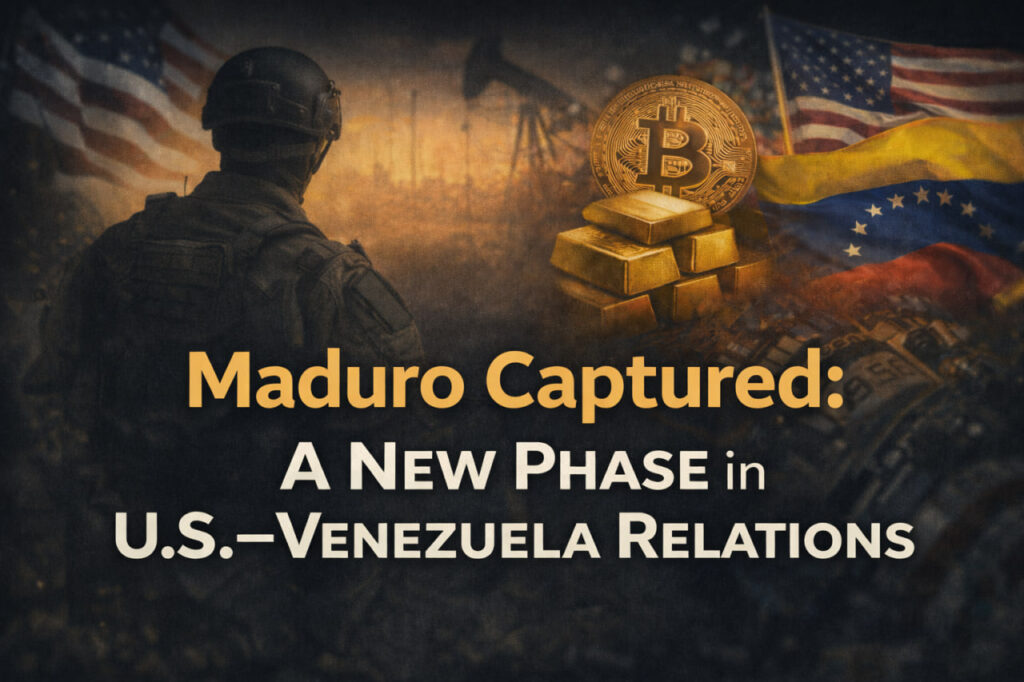
The geopolitical landscape in Latin America has shifted decisively. What began as a high-risk U.S. operation in Venezuela has now evolved into something far more complex: a hybrid of energy negotiations, asset control, and managed political transition.
With Nicolás Maduro now in custody, markets are no longer pricing military escalation. Instead, they are recalibrating around a new reality — one where oil flows, seized assets, and U.S. influence matter more than regime rhetoric.
This is no longer a crisis. It is a re-pricing event.
From Shock to Structure: What Changed This Week
The immediate fear premium that hit markets over the weekend has faded quickly. By mid-week, traders shifted focus from who controls Venezuela to who controls Venezuelan assets.
Three developments now define the situation.
1. The “Oil for Security” Framework
The most market-moving announcement came directly from Washington.
The United States confirmed it will receive 30–50 million barrels of Venezuelan crude, valued at approximately $2 billion, framed as reimbursement for the military operation and stabilization effort.
Why this matters:
- This is not a sanction.
- This is not a blockade.
- This is a supply re-routing agreement.
Instead of choking Venezuelan exports, the U.S. is accelerating them — under U.S. supervision.
Market reaction:
- Crude oil initially spiked on geopolitical risk.
- Prices quickly reversed as traders realized supply is being unlocked, not restricted.
- WTI drifting back toward the high-$50s reflects relief, not weakness.
This signals a critical shift: energy security now outweighs geopolitical punishment.
2. The Bitcoin “Shadow Reserve” Risk
A second shock is quietly dominating crypto desks.
Intelligence disclosures suggest the former Maduro regime accumulated an estimated 600,000 BTC, potentially worth $55–60 billion, outside formal reserves.
This revelation has introduced a rare macro-crypto risk:
- If seized and frozen: Bitcoin supply tightens → structurally bullish
- If seized and liquidated: One of the largest forced sell risks in crypto history
So far, Bitcoin’s behavior has been telling.
Despite headline risk, BTC is holding near $94,000, trading more like digital sovereign insurance than a speculative asset.
The market is not panicking.
It is waiting for clarity.
3. A Managed Political Transition, Not Occupation
Early speculation about direct U.S. control has faded.
Instead:
- Delcy Rodríguez has been sworn in as interim president.
- The Venezuelan military has publicly backed the transition.
- Washington has shifted language from “control” to “advisory oversight.”
This matters enormously for markets.
A power vacuum would have triggered:
- Civil instability
- Supply disruption
- Regional contagion
A managed transition does the opposite:
- Reduces tail risk
- Encourages capital planning
- Opens the door to reconstruction contracts
Markets are already responding accordingly.
Market Impact Snapshot (As of Jan 7, 2026)
| Asset | Market Interpretation |
|---|---|
| Crude Oil | Neutral to bearish as supply fears fade |
| Gold | Firm, supported by geopolitical legitimacy concerns raised by China & Russia |
| Energy Stocks | Strongly bid on reconstruction and service demand |
| US Dollar | Supported by capital safety flows |
| Bitcoin | Volatile, but behaving defensively |
This is not a panic trade.
It is a reallocation trade.
The Bigger Picture: What This Really Signals
A Crack in OPEC+ Influence
If Venezuelan production becomes effectively aligned with U.S. energy policy, OPEC’s ability to manage supply tightens materially. This introduces a long-term pressure point for oil pricing power.
A More Assertive U.S. Hemisphere Policy
Markets are beginning to price a renewed version of regional dominance. Expect sensitivity in Latin American currencies, especially those with fiscal or political fragility.
Asset Seizure as a Financial Weapon
The potential handling of Venezuelan Bitcoin reserves sets a precedent. Sovereign crypto holdings are no longer theoretical — they are now a legal and strategic battleground.
Bottom Line
The capture of Maduro was the headline.
The control of energy, reserves, and transition is the real story.
Markets are no longer trading fear.
They are trading who holds the leverage next.
This episode is not closing volatility — it is redefining where it comes from.
Join Fremora’s Free Telegram Channel
Clear macro context. Real-time market interpretation. No noise.
👉 t.me/FremoraFree